Learning in the Age of AI
How Funders Can Meet the Moment
Young people are inheriting a world being rapidly reshaped by artificial intelligence. As AI transforms how we learn, work, and participate in society, it also creates an opportunity to reimagine what learning is for and how we prepare young people for the future. This report explores what learners may need to thrive in a world that will more and more be shaped and influenced by AI, and how schools and school systems may need to evolve to meet the moment.
This is not a technology adoption question. It is a question of human development. AI doesn’t change what we want for young people. But it does give us a rare opportunity to turn disruption into transformation and make those aspirations achievable for every learner, not just an elite few.
Drawing on conversations with more than 50 educators, researchers, technologists, parents, community leaders, funders, and young people across 16 countries, this report synthesizes the ideas, questions, and opportunities that emerged. Rather than prescribing a single vision, it offers a set of guideposts to help our field navigate this moment with humility and ambition—and find opportunities for collaboration.
Our Takeaways
A Call to Action for our Fellow Funders
The future of learning won’t be shaped by a single idea or organization. It will emerge through multiple, iterative experiments, collaborations, and partnerships. As you explore this report, we invite you to approach it with these principles in mind.
Hold curiosity and caution in equal measure. No one has all the answers right now. Stay committed to learning, to questioning your own assumptions, and to engaging in good-faith disagreement. Ask yourself: Where might you be hesitating, and what is one small step you can take to get unstuck?
Act, however imperfectly. Find the parts of this vision that move you, and make a few early investments. This could be to trusted collaborators, to new actors, or to pooled funds for joint experimentation. Be part of building the future, not just speculating about it or willing it away. Ask yourself: What are small investments you can make now to continue learning and support those on the front lines?
Stay in (cross-generational) conversation. Change is happening fast, but young people are learning faster. Adults must listen to and learn from young people leading the way—even when it’s uncomfortable. Ask yourself: Where can you bring youth voices into your work more deeply?
This moment calls for grounded ambition—backing the visions of educators, administrators, community leaders, and young people who are navigating change in real-time and who are imagining bold possibilities that are intimately connected to their understanding of the problem and possible solutions. As funders, it’s our responsibility to act, even as we continue to learn.
About the Research
Our research explored how the presence of AI in our society is reshaping learning across the arc from childhood to adulthood, and what those shifts might mean for the people and systems that support learners.

52
Research participants engaged through in-depth qualitative interviews

2
Co-creation sessions with young people

30+
Reports, articles, and podcast episodes reviewed via secondary research

16
Countries represented in the research across five continents
Our Insights
Our insights are divided into three levels where change is happening: learners, schools, and society.
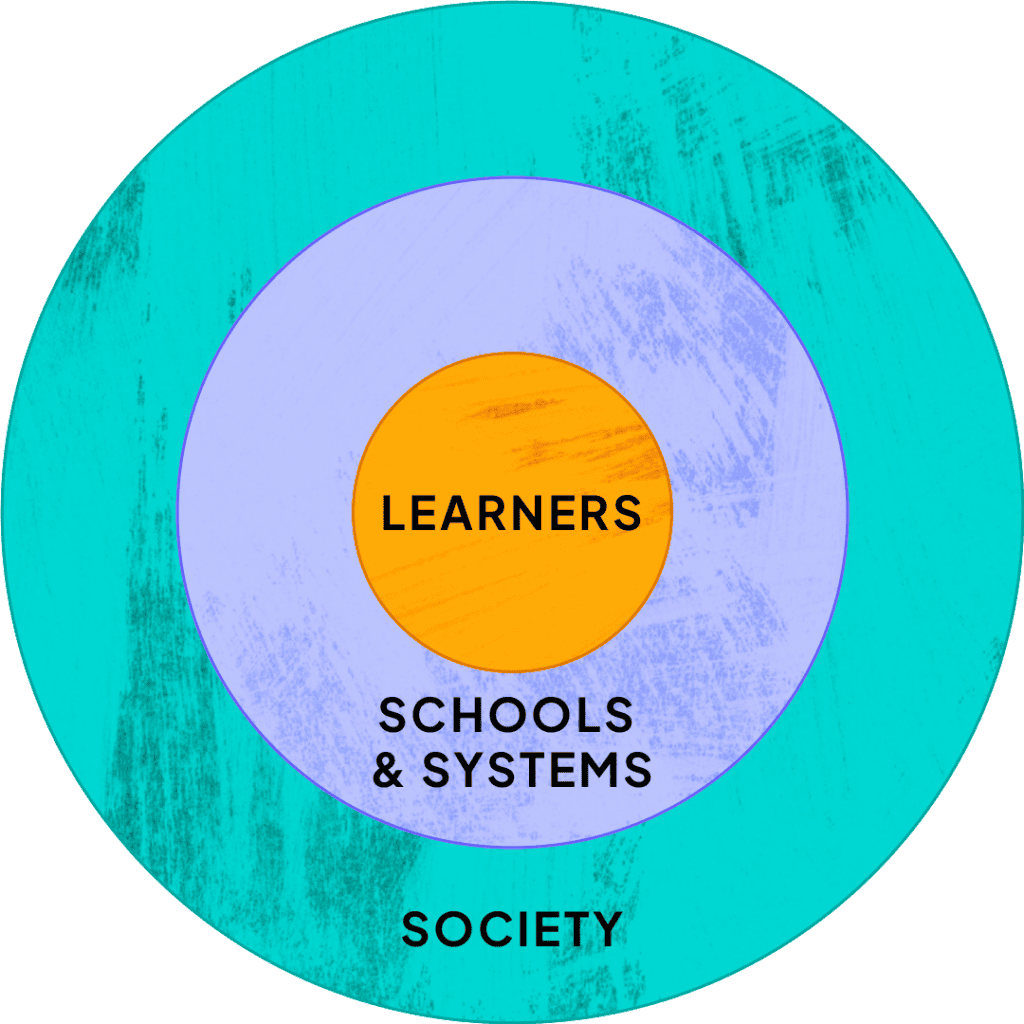
How are learners experiencing the challenges and opportunities inherently presented by an increasingly AI-mediated world?
How are schools and education systems responding, and what might be possible?
What is shifting (and what needs to be true) at a societal level to ensure learners thrive long-term?
“We haven’t engaged as educators in a conversation about what it means to be human. Maybe this is our opportunity.”
Education Funder
Thank You
We are also grateful to the experts who shared their time, trust, and insights but chose not to be cited. Their wisdom and insights are reflected throughout this report. Opinions expressed are those of the individual contributors, not their affiliated organizations.
Adam Barton, Anthropic
Alapaki Nahale-a, Islander Institute
Amy Hutchinson, SHOFCO
Andy Cunningham, Aga Khan Foundation
Babak Mostaghimi, Learner Studio
Becky Lee, Rebecca Lilian Lee Consulting
Bruce Au, Yidan Prize Foundation
Bundie Kabanze, Global Fund for Children
Christabel Netondo, Women Deliver
Cristóbal Cobo, World Bank
David Hsu, Omidyar Network
Dayoung Lee, Dalberg
Denis Ogada, MPesa Foundation Academy
Diane D’Costa, IDEO.org
Elisa De Padua Najera, Innova Schools
Emma Bruehlman-Senecal, Hopelab
Esra Salih, Teach For All
Eva Mkhitaryan, Teach For All
Felipe Proto, Lemann Foundation
Ghaith Bahmad, Teach For All
Gina Vieira Ponte, State Secretariat of Education, Brazil
Guilherme Cintra, Lemann Foundation
Heather Singmaster, Longview Foundation
Heitor de Araujo Martins, Arco Educação
Isabelle Hau, Stanford Accelerator for Learning
Izzy Boggild-Jones, Gates Foundation
Jhair Ventocilla, Teach For All
John Collery, Digital Green
Karen Sun, Insper Teaching College
Khairi Abdullah, Teach For All
Kristen Molyneaux, Lever for Change
Leo Wu, AI Consensus
Leonardo Medeiros, Realiza.vc
Libby Hills, EdTechnical
Linda Kamau, Akira Chix
Lofred Madzou, SkildMind
Luisell Valencia, Teach For All
Michael B. Horn, The Future of Education
Michael O’Bryan, humanature
Michelle Culver, The Rithm Project
Muthoni Gakwa, Metis Collective
Paula Anyiso, Butere Girls
Paula Menezes, Ministry of Education, Brazil
Potyratê Tupinambá, Pelas Mulheres Indígenas
Rabia Haidari, Teach For All
Rafael Siqueira, McKinsey
Rakesh Rajani, JustSystems
Renata Tomaz, FGV Comunicação
Robert Hakiza, YARID
Robert Palmer, Queen Rania Foundation
Sanaya Bharucha, Teach For All
Saurabh Chopra, Central Square Foundation
Simon Mutunga, Windle International
Simon Martin Sommer, Jacobs Foundation
Yakuy Tupinambá, Maloca Útero Tupinambá
Zainab Aljomaily, Teach For All
Research Team
Shauna Carey
Fernanda Pupe Colaço
Agnes Ogallo
Sommai Pham