
United States
We fund solutions that ensure that young children and their parents get the education they need for families to thrive, renewing the promise of our care and education systems. This year, we saw the power of collaboration and narrative change in achieving tangible wins for families, from expanding child care access on college campuses to deepening public awareness through sharing more authentic stories of care.
Securing Bipartisan Solutions for
Young Learners and Families
Supporting educational opportunities for our youngest learners — and their parents — transcends today’s partisan divides. Across the United States, cross-sector collaboration is driving bipartisan policy wins that improve access to education opportunities for more families, ensuring all learners can imagine and achieve better lives.
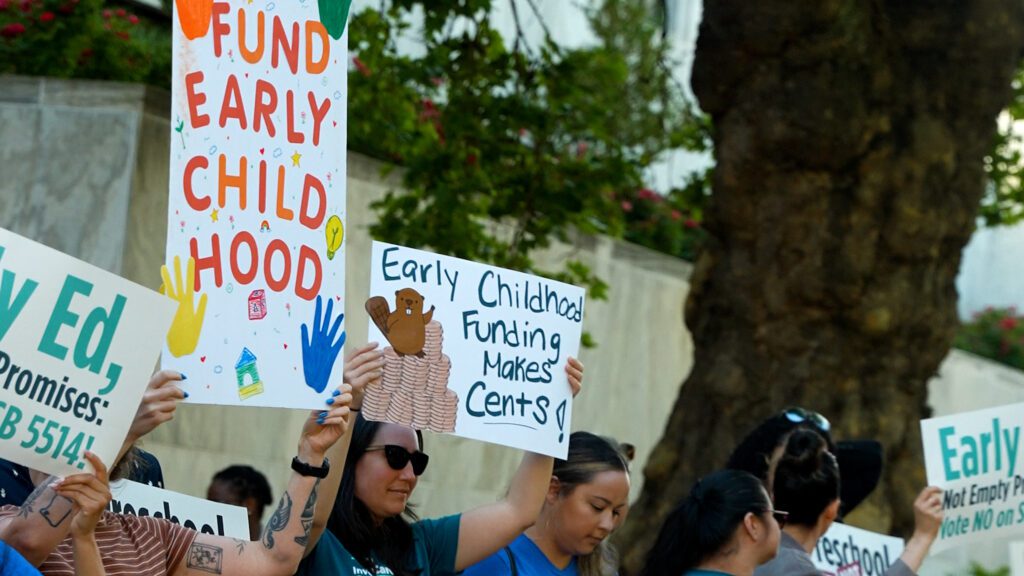
Our work with Impact Fellows Action Fund showed how early care and learning is an issue with broad appeal. As the leading multi-state 501(c)(4) focused solely on early childhood, Impact Fellows supports state-based organizations like the Kentucky Chamber of Commerce, which prioritizes child care and early learning advocacy out of recognition that pro-family policies are also pro-business. Their efforts show a model of policy development where business, philanthropy, government, and families come to the table as partners in change. In addition to piloting an innovative Tri-Share program, they also helped champion additional state funding for early care and learning — nearly tripling child care investments — and helped elect more child and family champions to office.
The California Alliance for Student Parent Success launched in January 2024 as the first formal statewide advocacy coalition focused on championing policies to support the one in five college students raising children. Building a broad cross-sector coalition spanning higher ed, business, labor, and human services, the Alliance successfully secured landmark legislation with AB 2458, the GAINS for Student Parents Act (GAINS Act), passing just nine months after launch. Now, other states are formalizing their advocacy networks to accelerate change for student parents. In Virginia, for instance, the College Attainment for Parent Students (CAPS) program scaled from five pilot community colleges to all 22 in the system due to high demand. Taking a page from the Alliance and other state-level efforts, Virginia leaders are formalizing their advocacy for state laws that will help improve data collection on parenting students.

From California to Kentucky and Virginia, we’ve seen how centering families’ needs and building diverse coalitions lead to transformative change, regardless of political climate.
Changing the Narratives on
Care & Learning


We know the stories we tell matter — both to how we understand the world around us and how we imagine the future that could be. For those working to change the narrative on care and learning, the opportunities for both audiences and creators are vast: Nine in ten television viewers want more realistic stories of family, caregiving, and work on screen. That’s why we focused on making narrative-building investments that help audiences imagine and make real a different world for learners.
This year, we partnered with creators, writers, and others in the entertainment industry to shine a brighter light on the parenting student experience. With the Writers Guide of America Foundation, we hosted a virtual webinar with television writers on how to craft authentic, compelling student parent characters. We collaborated with the Hollywood Radio and Television Society and Caring Across Generations to spotlight stories redefining resilience, including parenting students. Nicole Lynn Lewis, founder of Generation Hope and author of Pregnant Girl, joined showrunners and producers from The Pitt and Superman to explore new ways to frame education, work, and care for today’s audiences. At a Day of Unreasonable Conversation, hosted by Propper Daley-BPI in collaboration with Invisible Hand, we supported provocative discussions around the purpose of education and the care systems we need for all families to thrive. Together, these gatherings aimed to spark new storytelling on the education families need to thrive with the writers, producers, and executives who shape culture.
Building Momentum:
Stories of Progress
Kids On Campus
Kids on Campus tackles a critical barrier: the lack of affordable child care affecting over 3 million student parents. The partnership aims to open 50 Head Start centers on community college campuses within five years, expanding access to child care for parents and the broader communities served by the local campuses. Despite political headwinds at the federal level, the initiative has exceeded expectations — drawing interest from 185 institutions, matching 18 partnerships across 10 states, and launching programs in Maryland, Massachusetts, and Illinois — demonstrating strong momentum for expanding child care access on college campuses.
50
Head Start centers to launch on community college campuses within five years


EdSurge and The Hechinger Report
Dedicated early-childhood education (ECE) reporting fills a critical gap, spotlighting overlooked solutions and giving the public necessary information to demand accountability. This year, our support for The Hechinger Report and EdSurge delivered notable impact: Jackie Mader became the first ECE beat reporter to win recognition from the Education Writers Association for outstanding education beat reporting, and Emily Tate Sullivan’s Idaho reporting sparked statewide scrutiny of a proposal to loosen regulations on child care ratios, which informed changes to the final legislation.
Home Grown
Home-based care is the most common child care arrangement for American families. Yet, providers often earn poverty-level wages and are excluded from policy decisions. Home Grown is changing that: By 2025, the collaborative supported over 37,000 providers caring for 340,000 children and helped secure $433 million in public funding across 35 states. When Hurricane Helene devastated western North Carolina in late 2024, Home Grown launched an emergency fund that has helped over 1,000 providers recover from disasters nationwide.
37k
Home-based child care providers caring for 340,000 children supported