O conteúdo do nosso site é traduzido para o português com uso de inteligência artificial e, sempre que possível, revisado por humanos. Encontrou um erro? Entre em contato conosco.
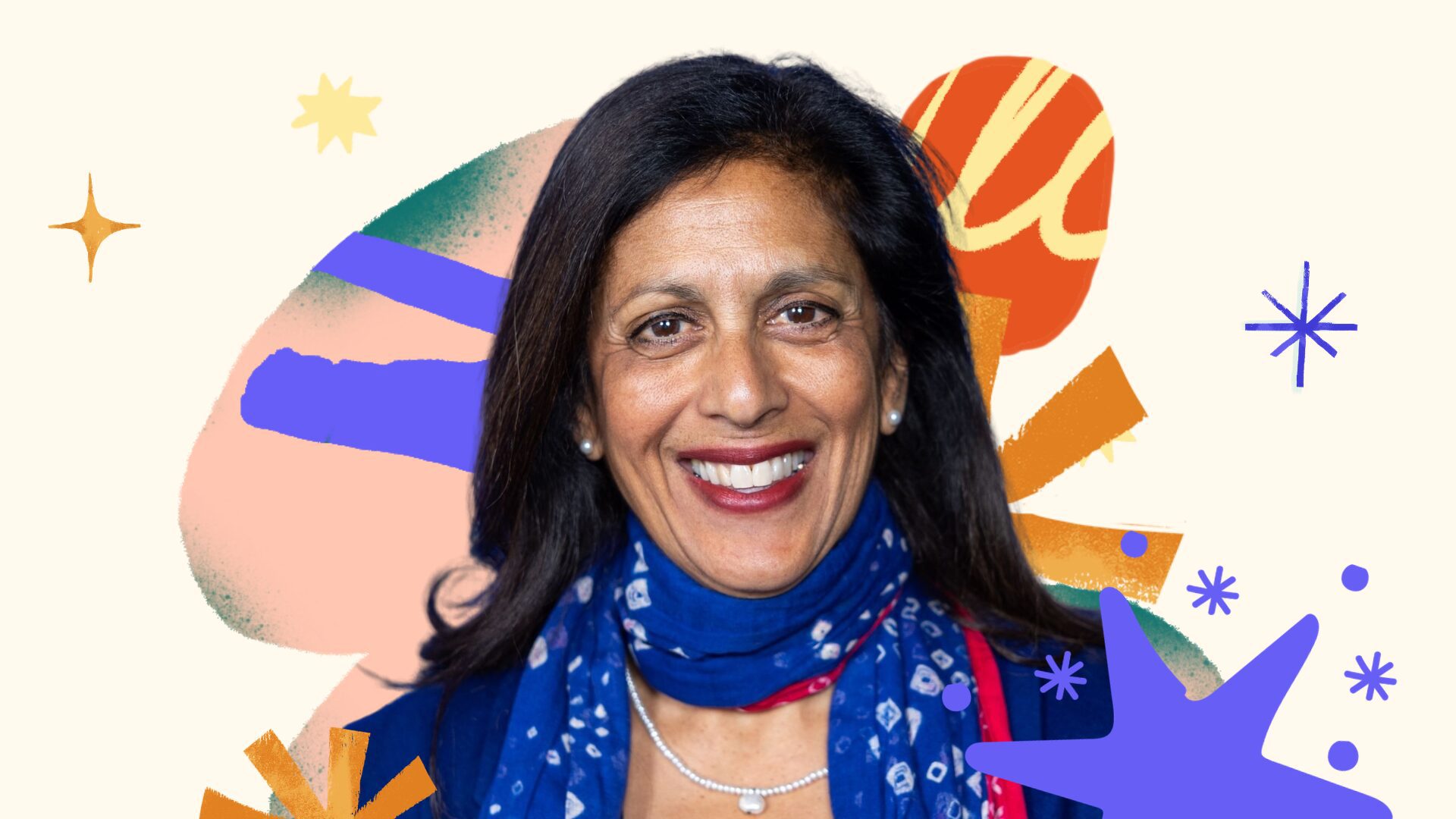
We’re excited to welcome Swati Adarkar as the new Head of US Programs at Imaginable Futures. With a career spanning early childhood policy, community-driven and state-based advocacy, and federal education leadership, Swati brings the passion and know-how to advance an expansive vision of our work in the US that connects early care, learning, and economic opportunity for families.
We recently sat down with her to talk about the experiences that shaped her, why she believes early care and learning are inseparable from economic opportunity, and what it will take to turn the possible into the inevitable for young learners and families.
Jenn: You’ve spent more than 30 years working on behalf of children and families — from nonprofits to local and federal government. Now you’re stepping into philanthropy. How has that experience shaped your approach?
Swati: Working across so many different settings — state, local, and federal — gave me the opportunity to learn from each of those seats and understand how systems work, or frankly don’t work. It’s allowed me to think more broadly and deeply about the policies, practices, and systems that can better serve kids and families.
A few things really stick with me. The first is how often policies are developed and implemented completely absent of input from families and communities. And time and again, we see that when that happens, those policies don’t deliver the intended benefits — and they don’t last. Truly engaging families authentically requires a real rethinking of how we do things, meeting people where they are, whether they’re in a rural or urban community, and resisting the pull toward silver-bullet solutions.
I’m also insistent on the importance of bridging what happens in the early years with the early grades — ensuring that services, supports, and opportunities are aligned across the birth-through-third-grade continuum. Right now, that work is siloed in almost every domain, including philanthropy. And my time at the federal level really underscored philanthropy’s unique role: to take more risks, innovate, make faster funding decisions, and test and learn.
Jenn: You also have experience in postsecondary education as well and we have many partners working to support the success of student parents. What are the connections you’ve seen across the education continuum, from early learning to higher education?
Swati: I’m a big believer in two-generation approaches, and student parents sit right at that intersection. This theme has run through my work in a few different ways.
My very first job out of graduate school was at Children Now in California, where we developed accessible resources for expectant and parenting teens — students who needed support not just as parents, but as learners. And at the federal level, I worked on efforts to improve child care access for families, particularly CCAMPIS, a critical funding stream for on-campus child care.
When I served on the board of Portland State University, which serves many students who come from families with low incomes, I saw issues like food insecurity, housing, and child care come before the board regularly — and that gave me a very different vantage point on what student parents are actually navigating.
What I keep coming back to is this: Educational opportunity must continue across the life course. For many parents with low incomes, particularly mothers, education and training opportunities can transform the quality of life and stability of a family. I’ve seen how the two-gen experience is transformational. Through Early Works, we watched parents go back to school, earn their degrees and credentials, and in some cases return to work in the very classrooms where their children were learning. This developed community strengths and assets that endure. That kind of possibility is exactly what this work is about.
Truly engaging families authentically requires a real rethinking of how we do things, meeting people where they are…and resisting the pull toward silver-bullet solutions.
Swati Adarkar
Jenn: What has kept you motivated through the long arc of this work?
Swati: My love of children and my belief in their potential — and in our collective responsibility to make a difference. When you see that responsibility taken seriously, it’s worth every minute you put in.
I love the Fred Rogers quote: “One of the greatest dignities of humankind is that each successive generation is invested in the welfare of each new generation.” That’s the motivation to keep at it.
What I’ve learned along the way is the importance of paying close attention to implementation. We spend so much energy designing and advocating for programs and policies, and then fall short on the sticky part — actually implementing them well on the ground. I’ve also come to see the limitations of traditional research and evaluation approaches, which often don’t move fast enough to support scaling or engage the people most affected by the very services being studied.
Jenn: Can you say more about that — how you’ve approached research and evaluation differently?
Swati: Through Early Works in Oregon, we tried something called community participatory research. We were trying to understand community health and well-being, and our research team developed a survey. When we shared the questions with the community members who would be asking them door to door, they told us flatly: “These are questions we would never ask.” That moment forced us to shift from a clinical mindset to a relational one — to ask, what would you actually say to your neighbor? The questions community members proposed were surprisingly direct. The community members could ask these questions because they had trusted relationships.
When we brought the findings back to the community, nearly everyone said they’d never had the experience of being heard and then having their input returned to them for further reflection and action. An advocacy agenda grew directly out of that process — and our organization committed real resources to those priorities. That’s what it looks like when research actually serves the people it’s meant to help.
Jenn: How has education shaped your own family story — and how does that inform this work?
Swati: Education runs deep across generations on both sides of my family. My dad’s father grew up poor in a small rural village in India near Goa, won a highly competitive scholarship, and studied at Cambridge — one opportunity that changed the trajectory of the entire family. My father studied at Cambridge too, his sister at Oxford. On my mom’s side, her father led the Chemistry Department at Benares Hindu University and her mom started a Montessori program in her home. My mom was a community college math teacher — and frankly, the only reason I understood geometry. My own children are teachers too.
Being a child of immigrants runs deep in my thinking. My parents came here for educational opportunity, and it has been a defining feature of not only my family, but of the American experience for millions. It’s deeply troubling to see how many ways we are abandoning that promise right now.
A mentor of mine, Ruby Takanishi, used to repeat the saying: “Talent is universally distributed. Opportunity to develop that talent, sadly, is not.” That has never left me.
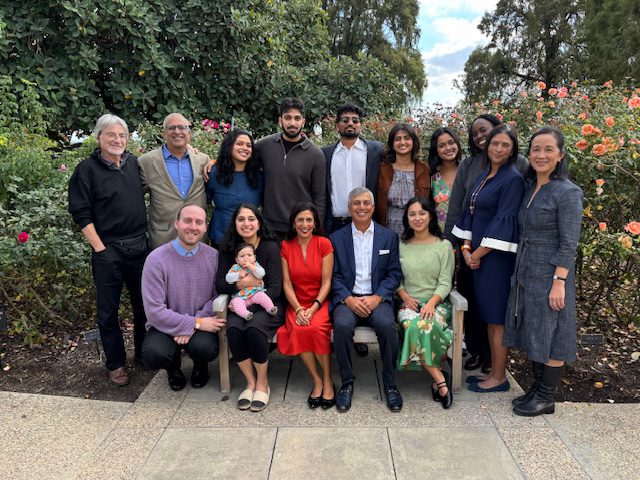
Swati and her family.
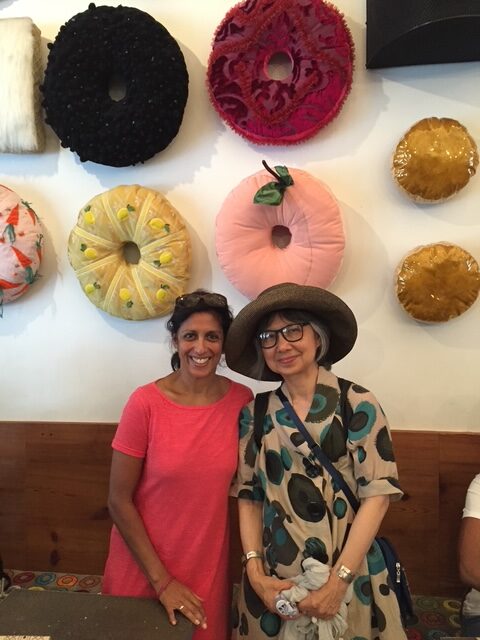
Swati with mentor Ruby Takanishi
Jenn:Imaginable Futures works across the US, Brazil, and Kenya. How do you see the potential to learn across those regions?
Swati: This was honestly one of the things that drew me to this role. Throughout my career, I’ve felt we’re missing a real opportunity by not doing more to learn across international and domestic contexts. People go on visits, see programs in other countries, and then it just… stops there.
I come to this with genuine humility — I have strong beliefs that development should be led by the people who live there, which is part of why I moved into domestic work rather than international development. But that doesn’t mean we can’t learn from each other.
I’m excited to support the US team in finding ways to more actively test and apply learnings from our work in Brazil and Kenya to better inform US policy and practice. There’s so much more we could be doing.
Jenn: If you could change one thing about how the US thinks about child care, learning, and economic opportunity, what would it be?
Swati: Commit to effectively eradicating childhood poverty. We have the resources and we know how to do it.
Jenn: Last question. What one word captures how you see the future of education in the US in this moment?